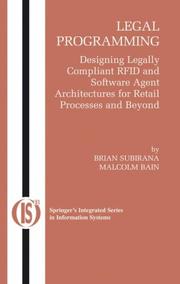
Legal Programming
Designing Legally Compliant RFID and Software Agent Architectures for Retail Processes and Beyond
The most advanced and ambitious aspect of ecommerce technology is the use of intelligent agent-based computing. Software agents are basically autonomous software entities that can react and interact with their environment, with more advanced intelligent agents being also adaptive, sociable and mobile. Agent technology is embryonic, current agent uses including network and system management, ecommerce decision and logistic support, organization and user assistance. These activities – and the related processes and programming – present serious and unresolved legal challenges, regarding issues such as privacy, confidentiality, electronic contracts, copyright issues and taxation. LEGAL PROGRAMMING: Designing Legally Compliant RFID and Software Agent Architectures for Retail Processes and Beyond provides a process-oriented discussion of the legal concerns presented by agent-based technologies, processes and programming.
It offers a general outline of the potential legal difficulties that could arise in relation to them, focusing on the programming of negotiation and contracting processes in a privacy, consumer and commercial context. The authors will elucidate how it is possible to create form of legal framework and design methodology for transaction agents, applicable in any environment and not just in a specific proprietary framework, that provides the right level of compliance and trust. Key elements considered include the design and programming of legally compliant methods, the determination of rights in respect of objects and variables, and ontologies and programming frameworks for agent interactions. Examples are used to illustrate the points made and provide a practical perspective. This focus on processes integrates both human and automatic machine activities within the same conceptual framework.
An analysis and understanding of the issues raised by the process (its characteristics and procedures) is valid for both forms of activities. Also, it is a useful tool to consider the differences between agents that integrate the business processes, as part of the corporate or commercial platform (and can be designed legally accordingly), and those that are independent but then have to interact with the system –making process standardization or trading protocols obligatory. In describing the processes, the legal challenges consider the differences between human and automated performance – and then consider programming methods and tools to achieve compliance. This understanding assists in designing and building a technical architecture and related workflow, which integrates legal compliance and other requirements into the agent programming.
| 제목 | Legal Programming: Designing Legally Compliant RFID and Software Agent Architectures for Retail Processes and Beyond |
|---|---|
| 저자 | Brian Subirana, Malcolm Bain |
| 출판사 | Springer London, Limited |
| 출간 | 2006 |
| 쪽수 | 314쪽 |
| 언어 | 영어 |
| ISBN | 9780387234151 |
배송
결제가 확인되면 해외 판매처에 주문을 넣습니다. 받으시기까지 보통 2~3주 걸립니다. 국내에 들어오면 택배 송장번호를 주문 화면과 문자로 알려 드립니다.
통관
개인 주문은 개인통관고유부호가 필요합니다. 주문서에 넣어 주시고, 받은 번호는 그 주문에만 씁니다.
취소, 반품
해외 주문 전에는 주문 화면에서 바로 취소하실 수 있고 전액 환불됩니다. 해외 주문 뒤에는 단순 변심 취소가 어렵습니다. 받으신 책이 설명과 크게 다르거나 파손되었으면 다시 구해 드리거나 환불합니다.