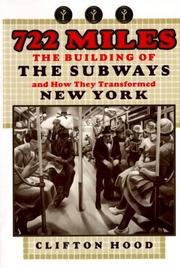
722 Miles
The Building of the Subways and How They Transformed New York
"The building of the New York City subway system was an epic struggle, and not just for engineering reasons." "As New York grew in importance throughout the nineteenth century, geography imposed physical limits on the city. Manhattan was a narrow and crowded island, with a huge population jammed into its southern tip. By the 1880s surface transportation on Manhattan streets was impossibly slow, and the city's business leadership realized that improved transportation was vital to its future. Mayor Abram S. Hewitt, a wealthy businessman, proposed a subway system, and Hewitt and other prominent businessmen established the political and financial framework for the city's first subway, which opened in 1904." "Hugely popular from its inception, the subway quickly became overcrowded. Expansion of the system was hindered by the autocratic August Belmont, a wealthy banker who operated and controlled the IRT subway. Belmont's efforts to preserve his transportation monopoly precipitated a confrontation with the nascent progressive political movement. The progressive reformers wanted to expand the subways to promote dispersal of the population into the outer boroughs of New York, especially the Bronx, Brooklyn, and Queens. Their success marked the end of the era of domination of city government by the mercantile elite.".
"The construction of the subway system - still the world's largest and, at 722 miles of track, long enough to extend from New York to Chicago if all the track were laid end to end - was a monumental engineering feat. Subway tunnels beneath the East River connected Manhattan with Brooklyn and Queens, and other tunnels beneath the Harlem River connected Manhattan and the Bronx. In northern Manhattan the subway lay nearly 200 feet deep beneath solid rock in the vicinity of Fort George; a construction accident there took the lives of ten men, all of them immigrants. (The subway system was built almost entirely by immigrant labor.)" "The subways were a success by every measure. They brought true rapid transit to New York for the first time. A worker from the Bronx or Queens could commute to a job in Manhattan every day; something that was impossible before the subways. The population shifted dramatically and would never again approach the density of the Lower East Side in the years before the IRT opened. The nickel fare was so popular that it became a political sacred cow and lasted long beyond the point where it made economic sense. The subways themselves became an integral part of New York's legend, celebrated in films, songs, and literature." "In 722 Miles, Clifton Hood has written a meticulously researched and wonderfully rich and vibrant work of urban history."--BOOK JACKET.
| 제목 | 722 Miles: The Building of the Subways and How They Transformed New York |
|---|---|
| 저자 | Clifton Hood |
| 출판사 | The Johns Hopkins University Press |
| 출간 | July 13, 2004 |
| 쪽수 | 336쪽 |
| 제본 | 무선(페이퍼백) |
| 언어 | 영어 |
| ISBN | 9780801880544 |
배송
결제가 확인되면 해외 판매처에 주문을 넣습니다. 받으시기까지 보통 2~3주 걸립니다. 국내에 들어오면 택배 송장번호를 주문 화면과 문자로 알려 드립니다.
통관
개인 주문은 개인통관고유부호가 필요합니다. 주문서에 넣어 주시고, 받은 번호는 그 주문에만 씁니다.
취소, 반품
해외 주문 전에는 주문 화면에서 바로 취소하실 수 있고 전액 환불됩니다. 해외 주문 뒤에는 단순 변심 취소가 어렵습니다. 받으신 책이 설명과 크게 다르거나 파손되었으면 다시 구해 드리거나 환불합니다.