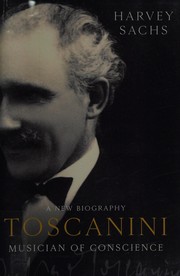
Toscanini
It may be difficult to imagine today, but Arturo Toscanini -- recognized widely as the most celebrated conductor of the twentieth century -- was once one of the most famous people in the world. Like Einstein in science or Picasso in art, Toscanini (1867-1957) transcended his own field, becoming a figure of such renown that it was often impossible not to see some mention of the maestro in the daily headlines. Acclaimed music historian Harvey Sachs has long been fascinated with Toscanini's extraordinary story. Drawn not only to his illustrious sixty-eight-year career but also to his countless expressions of political courage in an age of tyrants, and to a private existence torn between love of family and erotic restlessness, Sachs produced a biography of Toscanini in 1978. Yet as archives continued to open and Sachs was able to interview an ever-expanding list of relatives and associates, he came to realize that this remarkable life demanded a completely new work, and the result is Toscanini -- an utterly absorbing story of a man who was incapable of separating his spectacular career from the call of his conscience. Famed for his fierce dedication but also for his explosive temper, Toscanini conducted the world premieres of many Italian operas, including Pagliacci, La Boheme, and Turandot, as well as the Italian premieres of works by Wagner, Brahms, Tchaikovsky, and Debussy. In time, as Sachs chronicles, he would dominate not only La Scala in his native Italy but also the Metropolitan Opera, the New York Philharmonic, and the NBC Symphony Orchestra. He also collaborated with dozens of star singers, among them Enrico Caruso and Feodor Chaliapin, as well as the great sopranos Rosina Storchio, Geraldine Farrar, and Lotte Lehmann, with whom he had affairs. While this consuming passion constantly blurred the distinction between professional and personal, it did forge within him a steadfast opposition to totalitarianism and a personal bravery that would make him a model for artists of conscience. As early as 1922, Toscanini refused to allow his La Scala orchestra to play the Fascist anthem, "Giovinezza," even when threatened by Mussolini's goons. And when tens of thousands of desperate Jewish refugees poured into Palestine in the late 1930s, he journeyed there at his own expense to establish an orchestra comprised of refugee musicians, and his travels were followed like that of a king. Thanks to unprecedented access to family archives, Toscanini becomes not only the definitive biography of the conductor, but a work that soars in its exploration of musical genius and moral conscience, taking its place among the great musical biographies of our time.
| 제목 | Toscanini |
|---|---|
| 저자 | Harvey Sachs |
| 출판사 | Pavilion Books |
| 출간 | 1993 |
| 쪽수 | 382쪽 |
| 언어 | 영어 |
| ISBN | 9780860518587 |
배송
결제가 확인되면 해외 판매처에 주문을 넣습니다. 받으시기까지 보통 2~3주 걸립니다. 국내에 들어오면 택배 송장번호를 주문 화면과 문자로 알려 드립니다.
통관
개인 주문은 개인통관고유부호가 필요합니다. 주문서에 넣어 주시고, 받은 번호는 그 주문에만 씁니다.
취소, 반품
해외 주문 전에는 주문 화면에서 바로 취소하실 수 있고 전액 환불됩니다. 해외 주문 뒤에는 단순 변심 취소가 어렵습니다. 받으신 책이 설명과 크게 다르거나 파손되었으면 다시 구해 드리거나 환불합니다.